Seeing Through Fangs: The Camera Tricks That Put You Inside a Predator's Head
There's a shot about twenty minutes into Natural Selection that audiences consistently describe the same way: unsettling. Not scary, exactly. Not violent. Just deeply, quietly unsettling. A wide grassland. Heat shimmer on the horizon. And then the frame begins to move — low, deliberate, almost patient — toward a grazing herd that has no idea what's coming.
You're not watching a predator. You are one.
That effect didn't happen by accident. It took cinematographer Dara Osei and director Milo Carver the better part of two years to develop a visual grammar that could translate non-human perception into something a theater audience in Tulsa or Tacoma could feel in their chest. What they landed on is one of the most technically ambitious — and philosophically strange — approaches to nature filmmaking in recent memory.
Throwing Out the Wildlife Documentary Playbook
"The default mode for wildlife cinematography is basically God-cam," Osei says. "You're elevated, you're distant, you're safe. The framing says: we are observers, they are subjects. That's a beautiful tradition, and it's produced incredible work. But it was the exact opposite of what we needed."
Carver had been explicit from early pre-production: he didn't want audiences to feel sympathy for the predators. He wanted them to feel as the predators — and then sit with what that means. That required dismantling almost every conventional instinct Osei had built over a fifteen-year career.
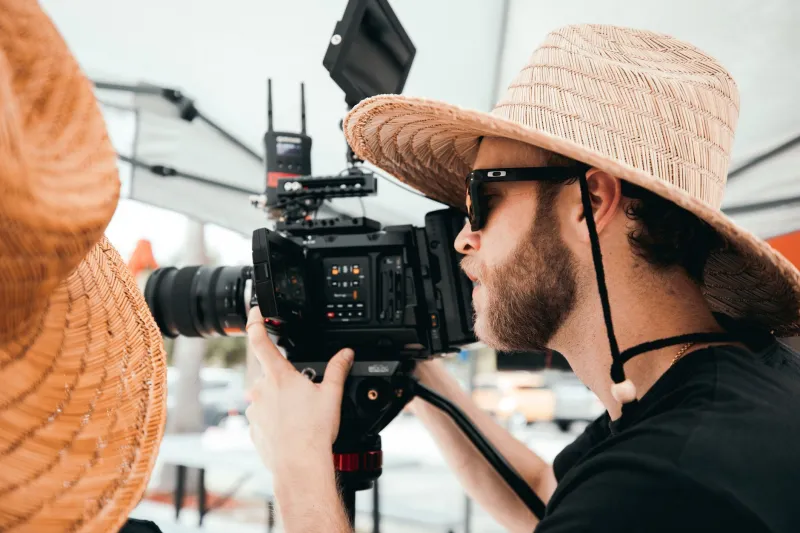
The first thing to go was the long lens. Traditional wildlife filmmaking relies heavily on telephoto glass — it keeps crews safe, compresses distance beautifully, and creates that lush, intimate-yet-removed quality you associate with prestige nature docs. Osei ditched it for wide-angle and ultra-wide primes whenever the script put the camera in a predator's point of view.
"Wide lenses exaggerate depth and motion," he explains. "When you're moving through space with a wide angle, the environment rushes toward you. It's visceral. It puts you in the landscape rather than looking at it from across the savanna."
Color Grading at the Edge of Human Vision
The visual trickery goes deeper than lens choice. One of the film's most talked-about technical decisions involves its color grading — specifically, the way certain sequences subtly shift the spectrum to approximate how different predators actually perceive light.
Felines, for instance, have limited color differentiation compared to humans but dramatically superior low-light sensitivity. Scenes shot from a lion's approximate perspective in Natural Selection carry a slightly desaturated midrange with crushed shadows that suddenly open up — the world rendered in luminance rather than hue. It's disorienting in exactly the right way.
"We worked with a visual neuroscientist out of UC San Diego to make sure we weren't just making stuff up," Carver says. "We weren't trying to be a biology lecture, but we wanted the perceptual shifts to have a real foundation. If you're going to ask an audience to inhabit a different kind of consciousness, you owe them something honest."
The grading work was done in collaboration with colorist Janelle Firth, who spent months building custom LUTs — lookup tables that define color translation in post-production — for each predator species featured in the film. The result is a movie that quietly changes its own visual rules depending on whose perspective you're occupying, often without calling attention to the shift.
Sound as a Sensory Expansion Tool
If the cinematography reframes where you are, the sound design reframes how you're processing information. Supervising sound editor Tomás Riera approached the predator sequences as exercises in sensory hierarchy inversion.
"Human beings are primarily visual creatures," Riera explains. "We trust our eyes first. But a lot of the animals in this film are leading with smell, or with vibration, or with hearing ranges we don't even have access to. So the question became: how do you communicate a sensory priority that isn't native to your audience?"
His solution was to build layered sound beds that push certain frequencies forward during predator POV sequences — low subsonic rumbles that you feel more than hear, high-frequency environmental details that most films would bury in the mix. The effect isn't always consciously noticeable, but test screenings consistently showed that audiences reported feeling "more alert" and "weirdly focused" during those sections.
"That's exactly what we wanted," Riera says. "That's what a hunting animal feels like. You're not relaxed. Every input matters."
The Frame as a Hunting Tool
Beyond lens choice and color, Osei developed a specific framing philosophy for the film's predator sequences. Traditional cinematography tends to center subjects — faces, action, emotional focal points sit in the middle of the frame where the eye naturally goes. Osei's predator shots frequently don't.
"Predators don't center their prey," he points out. "They track from the periphery. They use the full field of vision. So we started composing shots where the most important information — the thing being hunted — is at the edge of the frame. It creates this low-level anxiety because your eye keeps getting pulled to where it's not supposed to go."
Carver describes watching early cuts of these sequences with the sound off and feeling genuinely uncomfortable. "Which is wild, because you're just looking at animals in a field. Nothing is happening yet. But the framing alone makes you feel like something is about to."
What It Means to Watch This Way
There's a broader question lurking under all of this technical innovation — one that Carver is happy to sit with rather than answer cleanly. When you engineer a viewing experience that makes a human audience identify with a predator, what are you actually doing to them?
"I think you're temporarily dissolving a fiction that we carry around all the time," he says. "The fiction that we're separate from nature. That we're observers of a system we're not part of. Every human being has predator instincts — we evolved with them. We've just built a lot of culture on top of them."
The film doesn't moralize about that. It doesn't tell you how to feel about the hunt you just experienced from the inside. It trusts you — and that trust, maybe more than any single camera trick, is what makes Natural Selection feel genuinely different.
When the lights come up, you'll have a lot to think about. Some of it will be about the movie. Some of it, if Carver and Osei did their jobs right, will be about yourself.